
Hi all! I am sorry I have not been updating you all on my life or blogging since we went to Disneyland. Truth is, I actually have been super busy with my Junior year of college, which is coming to an end in June (that is so crazy to think about by the way) and I, personally, have not been traveling since Disneyland, except to go back home. But my family has been as my brother is a Junior in high school so they have been touring colleges. I obviously cannot write about their experiences as I am usually not with them.
Anyways, this brings me to this blog post. This term I am taking a course called “Understanding Disney” and yes, that is actually the name for it. We recently wrote an analysis paper where we had to analyze a Disney film, character or product. I, of course, chose Captain Marvel (2019) which was released almost a year ago this month. I told myself that if I had gotten a good grade on the assignment, I would post the essay on my blog because it is on two things I am passionate about, Captain Marvel and feminism. I received a 93% so therefore, I hope you all enjoy!
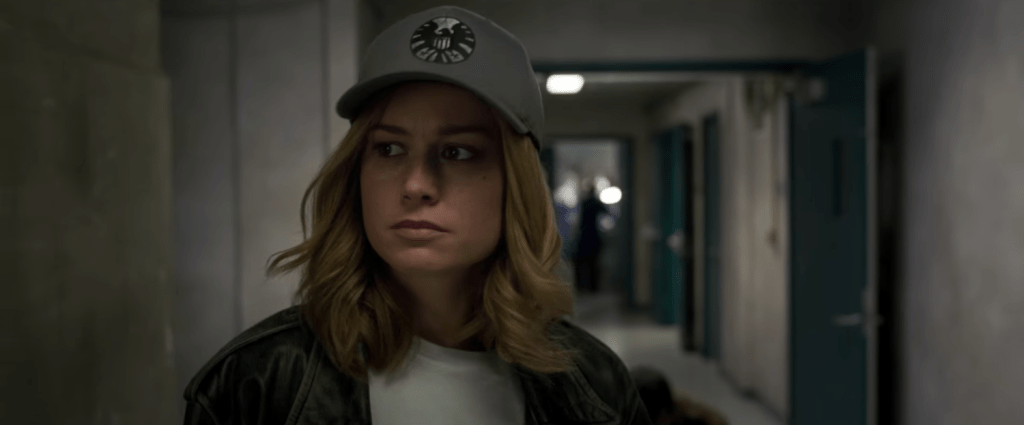
On March 8th, 2019, Marvel Studios released the hit film, Captain Marvel, their first superhero origin story about a female heroine. The film would go on to be a smashing success, making over one billion dollars in total box office sales. Carol Danvers, or Captain Marvel as she is formally called, has since become a symbol for the extremely popular movement, feminism as well as an icon for female empowerment. Feminism is defined as the advocacy of women’s rights based on the equality of the sexes. There have been multiple portrayals of female heroines in comic books and films, especially in recent years. Therefore, women in comic books are not anything new or unfamiliar, but Marvel’s portrayal of the character that has existed in the comics for years is what made the heroine successful. Marvel Studios chose to portray Carol Danvers as an independent woman, a powerful superheroine who does not abide by anyone’s rules and they also do not give her a love interest like all other heroes have.
In the film, Captain Marvel is portrayed by Brie Larson, who has always been very vocal about gender equality and human rights. The announcement of her casting, angered people from the start, especially the men, but for women, she acted as the voice to what all women wanted, recognition. Throughout the history of Marvel comics, as well as Marvel’s films, all of the women in them were forced to identify with male characters, usually as the love interests. Captain Marvel (2019) changed the game and showed people of all gender how all women should be portrayed, strong and capable of almost anything. For the first time, women can see themselves within a character like how men saw themselves in Indiana Jones or Captain America. In the flashback sequences that occurred throughout the film, she is shown as constantly falling or failing at the task at hand and then getting back up and trying again and again until she succeeds. She was also told constantly by men that she was not allowed to do the same thing as the boys or that she would never be something simply because a man could do it better. She was not going to give up until she succeeded, which resonated with many women because they finally felt like they were being heard.
Her origin story, especially the flashback moments where she is shown to be failing but then getting back up over and over again, displayed moments of raw power. She shows everyone that just because she can do everything a man can do, does not mean she does it as a man does. She does it in her nuanced way. President of Marvel Studios, Kevin Feige, has also stated multiple times on multiple different occasions that she is the most powerful hero in the Marvel Cinematic Universe, much to men’s dismays. The team behind the camera was also mostly women as well; one of the directors, the screenwriters, the costume designer, and the composer are all women. The team of women behind the scenes helped create a film that could resonate with women and girls and make them feel like they were finally being inspired. It also features riot grrrl anthems and other bangers from bands that either had a female member or were made up of entirely women. The team at Marvel Studios wanted this film to be a feminist film since its announcement. Brie Larson was announced to be playing the role of Captain Marvel during the final moments of Marvel’s Hall H panel at San Diego Comic-Con in 2016. Captain Marvel (2019) made history by being a film that was led by a female and then again when it would go on to make over one billion dollars worldwide in box office sales.
Throughout the history of the world, women are seen as being weak and of lesser to men. They are either used as sexual ploys to grab men’s attention or as the “help” as maids or servants to a male boss. In Streiff and Dundes’ essay, “Frozen in Time: How Disney Gender-Stereotypes Its Most Powerful Princess,” they discuss feminism through the movie Frozen (2013), but I think what they wrote can be used to analyze Captain Marvel (2019) as well. When it comes to having a love interest, in the movie Frozen (2013), Elsa does not have one, and neither does Carol, “There is undoubtedly merit in having an attractive, strong female character who is happy without a romantic relationship…However, Elsa’s power appears to both substitute for romance and deter male suitors who risk emasculation in having a love interest who is powerful.” (Streiff & Dundes). This can be said for Carol Danvers’s powers as well. The person who trains Carol to hold back her abilities or powers is Yon-Rogg, played by Jude Law, who the audience will later find out to be the “villain” of the film. The audience and the characters do not experience the full extent of what Captain Marvel can do until the third act of the film when she breaks out of captivity that Yon-Rogg had her in via the line, “I’ve been fighting with one arm tied behind my back, but what happens when I’m finally set free.” Carol Danvers was trained to hold her powers back to get control of her emotions which she is shown to be doing throughout the film and in the training sessions at the start of the film. Although, the training scene in which Vers (short for Carol Danvers) and Yon-Rogg are fighting, one can assume that she is being told to suppress her impulses such that he still has the upper hand.
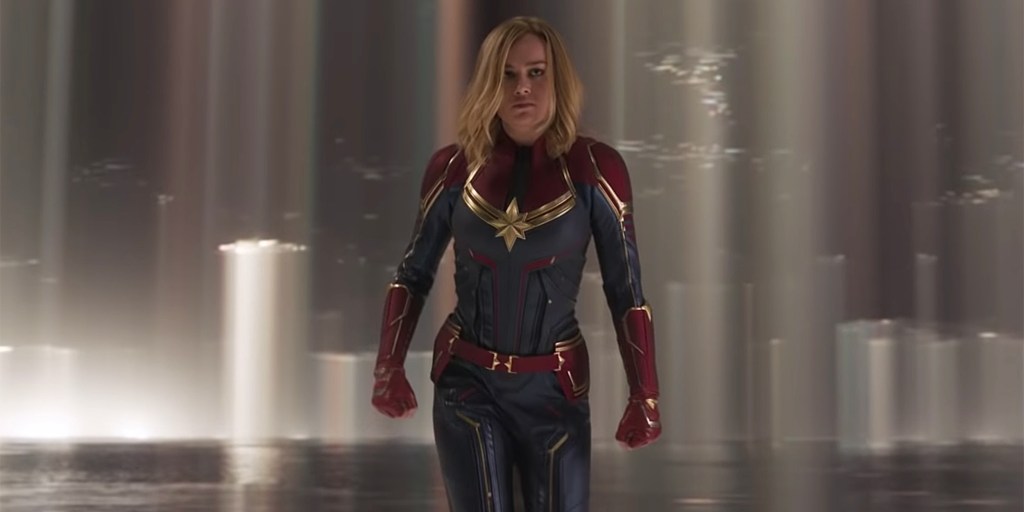
In terms of her body shape, as for any Marvel film, Brie Larson had to train significantly for the role, so her body is more built compared to the sexy bodies of the women in most other films. They were trying not to make Carol Danvers a subject of the male gaze as, throughout the film, she is shown as having costumes that fully cover her, from her Air Force jumpsuit to both the Kree and her super suit, and the clothes she changes out of when she arrives on Earth and is working with Nick Fury. Her figure and her strength display how Captain Marvel is like the other heroes and should be treated with as much respect as other heroes, but the only difference is that she is a woman and is thus, treated like a woman, especially online. Many men were vocal about their hatred of the character and the film from the very beginning, claiming that they are tired of “identity politics” or “making a female-led film after ten years of men.” Marvel felt like it was the time to introduce a female heroine that young girls could be inspired by, as it had been ten years with male-led superhero films. It had been ten years where girls and women alike did not feel like they were being seen as strong and capable. Captain Marvel represents strength and power to all girls all around the world.
In short, through the film’s displays of raw female empowerment and lines that were written to showcase Carol Danvers’s strength and confidence, it is no wonder why Captain Marvel (2019) is a hit. The film inspired millions, but it also inspired me. I came out of Captain Marvel (2019) feeling like I could accomplish anything I set my mind to because I saw Carol do just that on screen. I have been a Marvel Cinematic Universe (MCU) fan since the first Captain America and, therefore, have seen around half of the 24 films within the universe, so I know how the heroes are and have been portrayed. In my opinion, there is nothing like Carol Danvers and there is not a movie like Captain Marvel (2019) within the MCU. This film felt different to me upon the first viewing because I felt like I was being heard as a young woman. The previous 22 or so films all starred male heroes or had mostly male characters (i.e. The Avengers and Guardians of the Galaxy) so I could never identify with them as much as I can identify with Captain Marvel. Marvel Studios’ goal with Captain Marvel (2019) was to make females feel empowered, strong and capable, and I believe they did just that.
Works Cited, as I do not own any of the information included in the essay:
- Madeline Streiff and Lauren Dundes, “Frozen in Time: How Disney Gender-Stereotypes Its Most Powerful Princess,” Social Sciences, 2017, 6, 38, pp. 1-10.
With information inspired by:
- Lattila, Maria. “How CAPTAIN MARVEL Helped Me Realize I’m A Feminist.” Film Inquiry, 24 Apr. 2019, www.filminquiry.com/captain-marvel-feminist/.
- Tan, Shelly. “Becoming Captain Marvel: A Feminist (and Not-so-Feminist) History.” The Washington Post, WP Company, 7 Mar. 2019, www.washingtonpost.com/graphics/2019/entertainment/captain-marvel-history/.
- Bradley, Bill, and Marina Fang. “See ‘Captain Marvel’ For The Feminism, Stay For The Space Cat.” HuffPost, HuffPost, 16 Mar. 2019, www.huffpost.com/entry/captain-marvel-feminism_n_5c8be147e4b0db7da9f30615.
 Ashley's Travel Diaries